
A custom engagement ring is usually presented as a single beautiful image, which is the least informative part of the process. What a jeweller actually buys when they commission CAD is the middle: the drawing that turns an idea into dimensions, the model that turns dimensions into something a caster can print, and the decisions in between that stop a lovely sketch from becoming an unwearable ring. This is one real order shown all the way through — a treble-clef engagement ring with a nesting wedding band, in platinum, for a client who wanted the piece to read as music before it reads as jewellery. Sketch, technical plan, CAD, renders. Nothing skipped.
The brief: make it read as music, not as a ring with a charm on it
The client came with an idea rather than a drawing: an engagement ring for a musician, built around a treble clef, with a wedding band that would sit against it rather than fight it. That last part is where most novelty-shape rings fall down. A motif applied on top of a solitaire looks like a motif applied on top of a solitaire, and the second band never quite fits it.
So the clef is not decoration here — it is the structure. It carries the centre stone in its curve, the pavé runs along the clef itself rather than around a separate halo, and the wedding band's own pavé line continues the sweep instead of interrupting it. Worn together the two rings read as one object; worn separately each still reads as a complete piece, which matters, because the wedding band spends its life on its own.
Step one — the concept sketch
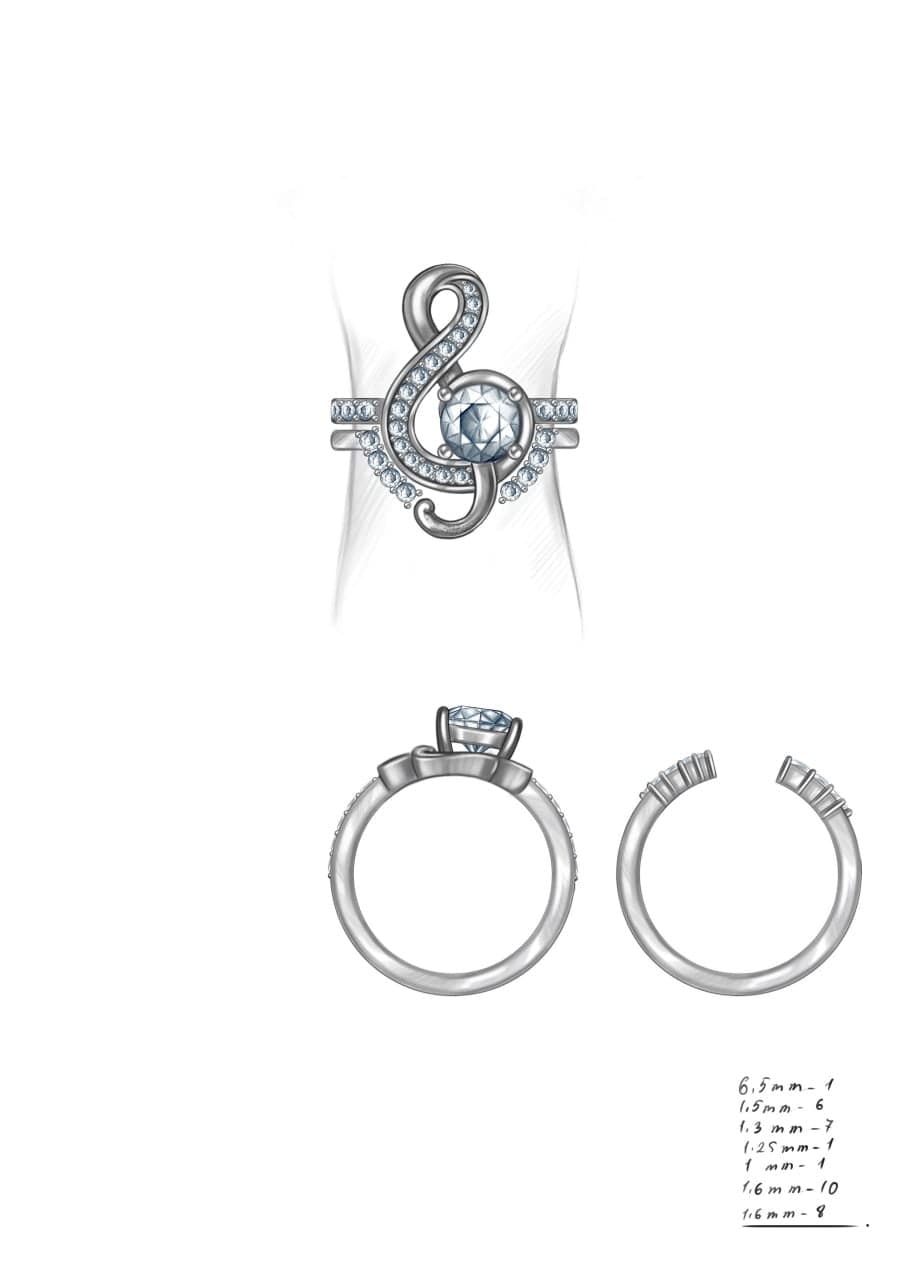
The first deliverable is a rendered sketch, not a model. It exists to settle proportion and character while changes are still free: how tall the clef stands over the finger, how much of the centre stone the curve is allowed to cover, whether the tail drops below the shank or tucks in.
It also settles the stone count in principle. You can see the beginnings of it in the corner of the sheet — sizes listed by diameter, because that is the language a setter and a stone dealer both speak. Approving a sketch costs nothing. Approving a model costs the modelling.
Step two — the technical plan
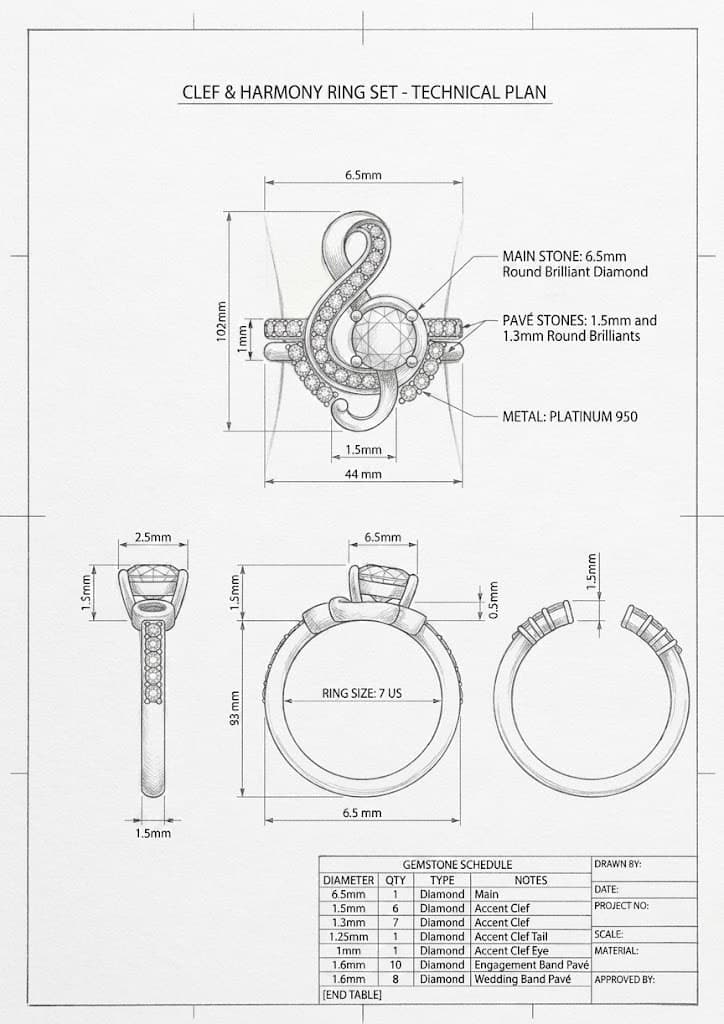
The plan is where an idea becomes a specification. Every dimension the workshop will ask about is answered on one sheet: the 6.5 mm round brilliant in the centre, the pavé at 1.5 mm and 1.3 mm, platinum 950, ring size 7 US, and the elevations that show how the head sits over the shank.
The part that saves the most time later is the gemstone schedule in the corner — every stone in the piece, by diameter, quantity and where it goes:
| Diameter | Qty | Where |
|---|---|---|
| 6.5 mm | 1 | Centre stone |
| 1.5 mm | 6 | Clef accents |
| 1.3 mm | 7 | Clef accents |
| 1.25 mm | 1 | Clef tail |
| 1 mm | 1 | Clef eye |
| 1.6 mm | 10 | Engagement band pavé |
| 1.6 mm | 8 | Wedding band pavé |
Step three — CAD, where the design meets physics
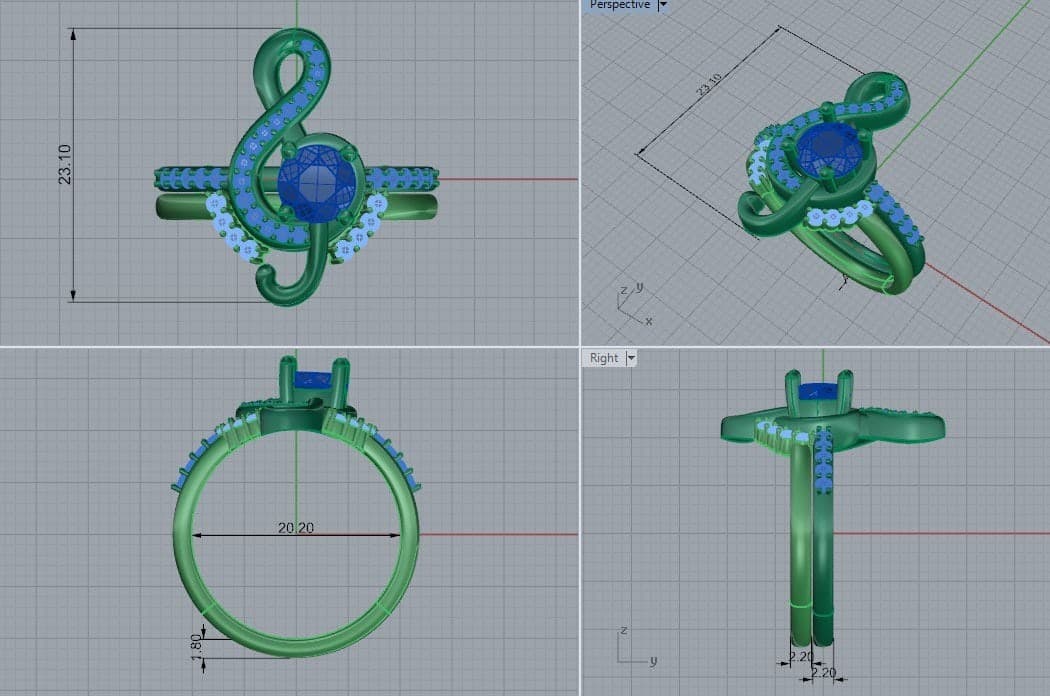
The model was built in Rhino, and the screenshot below is the working file rather than a presentation of it: four viewports, wireframe stones in blue, real millimetres on the dimension lines. 23.10 mm across the head, 20.20 mm across the shank, a 1.80 mm band, and the two rails of the set at 2.20 mm each.
A treble clef is an unusually awkward thing to build in metal, and almost none of the difficulty is visible in the finished renders. That is the point of this stage. Here is what actually had to be solved:
| The problem | Why it bites | What the model does about it |
|---|---|---|
| The clef is an open curve | It ends in mid-air. A cantilevered tail on a ring gets knocked against every door handle its owner meets | The tail is thickened toward its root where the eye does not read it, and its terminal curls back toward the shank so the piece has no true free end |
| Pavé along a curve that twists | Seats laid naively along a spiral leave stones reading crooked from the one angle a buyer looks from | Seats are distributed on a fitted rail, then each is re-oriented to the local surface normal so every table faces the viewer |
| Five different pavé diameters | The clef narrows as it curls; one stone size would either crowd the tip or leave gaps at the shoulder | Stones step down 1.6 → 1.5 → 1.3 → 1.25 → 1 mm along the run, so the line stays continuous as the metal narrows |
| Two rings that must nest | A wedding band designed after the fact either gaps at the clef or fouls the setting | Both bands were modelled together against the same centreline, with the clef's underside cleared for the second rail |
| Setting access | A stone that no setter can reach is a stone that never gets set | The clef's inner curve is opened enough for a graver to approach each seat, checked at finished size rather than in the viewport |
| Comfort against the skin | An open motif traps everything it touches and catches on fabric | The underside is closed and rounded, and the whole silhouette is checked for snag points before the file leaves |
Step four — the renders
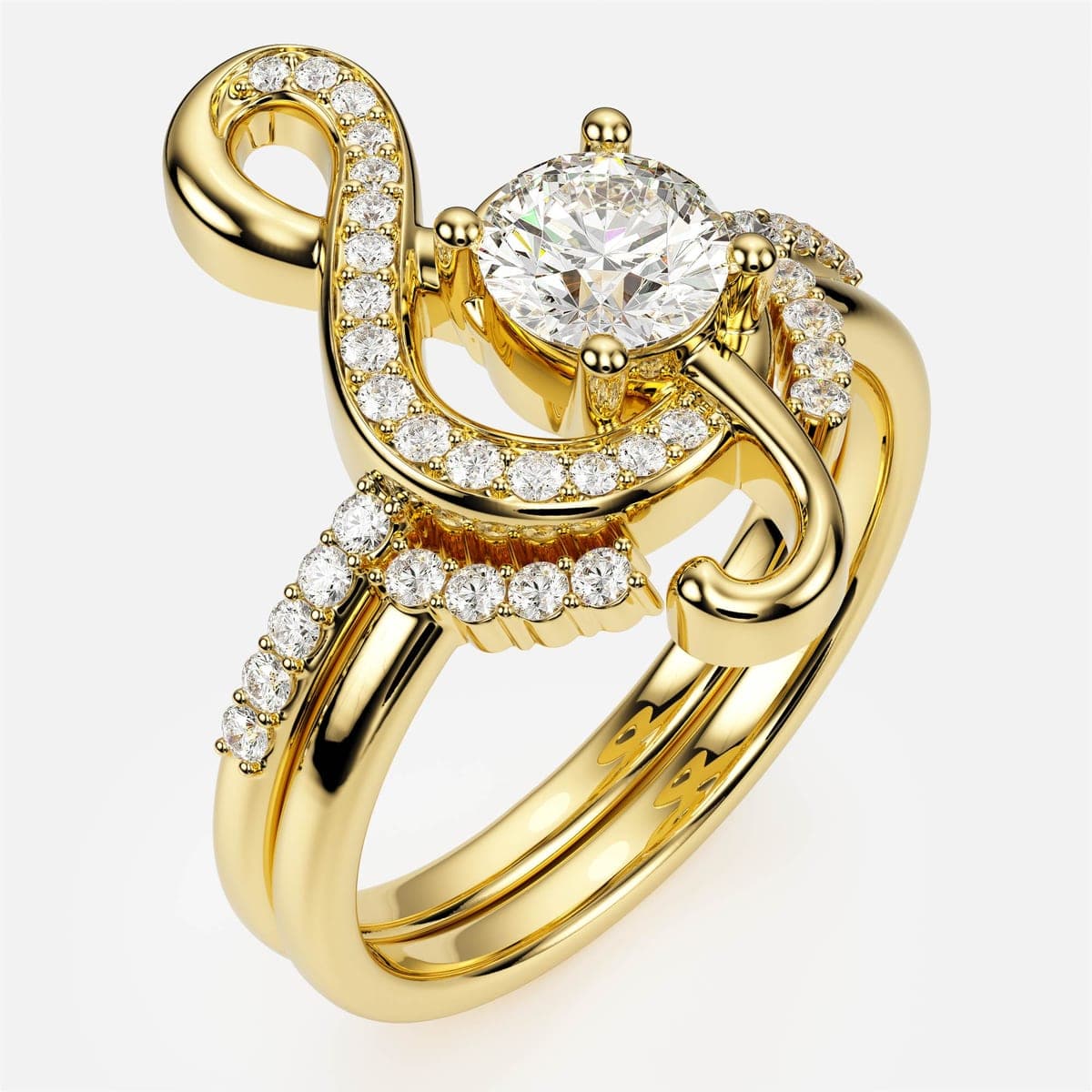
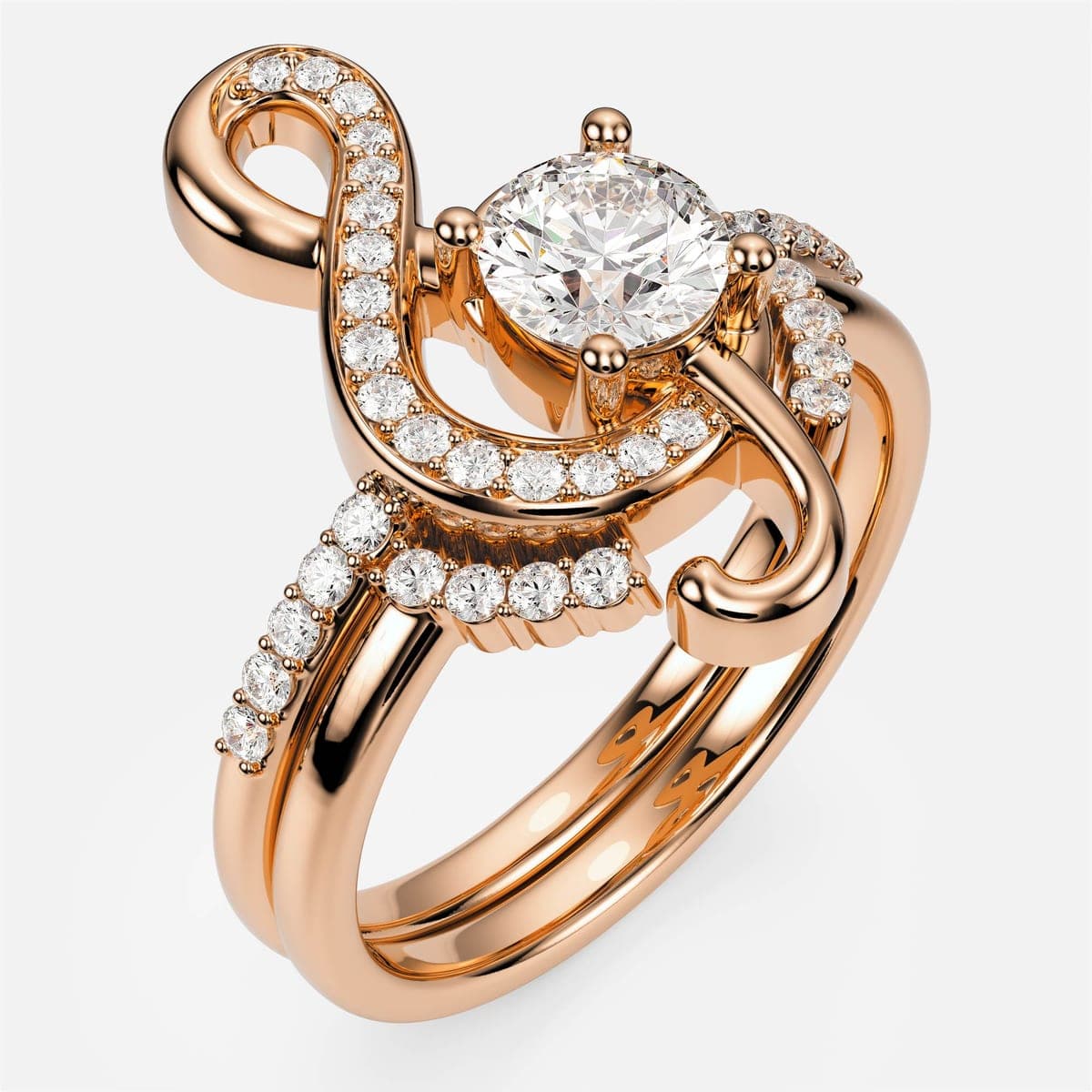
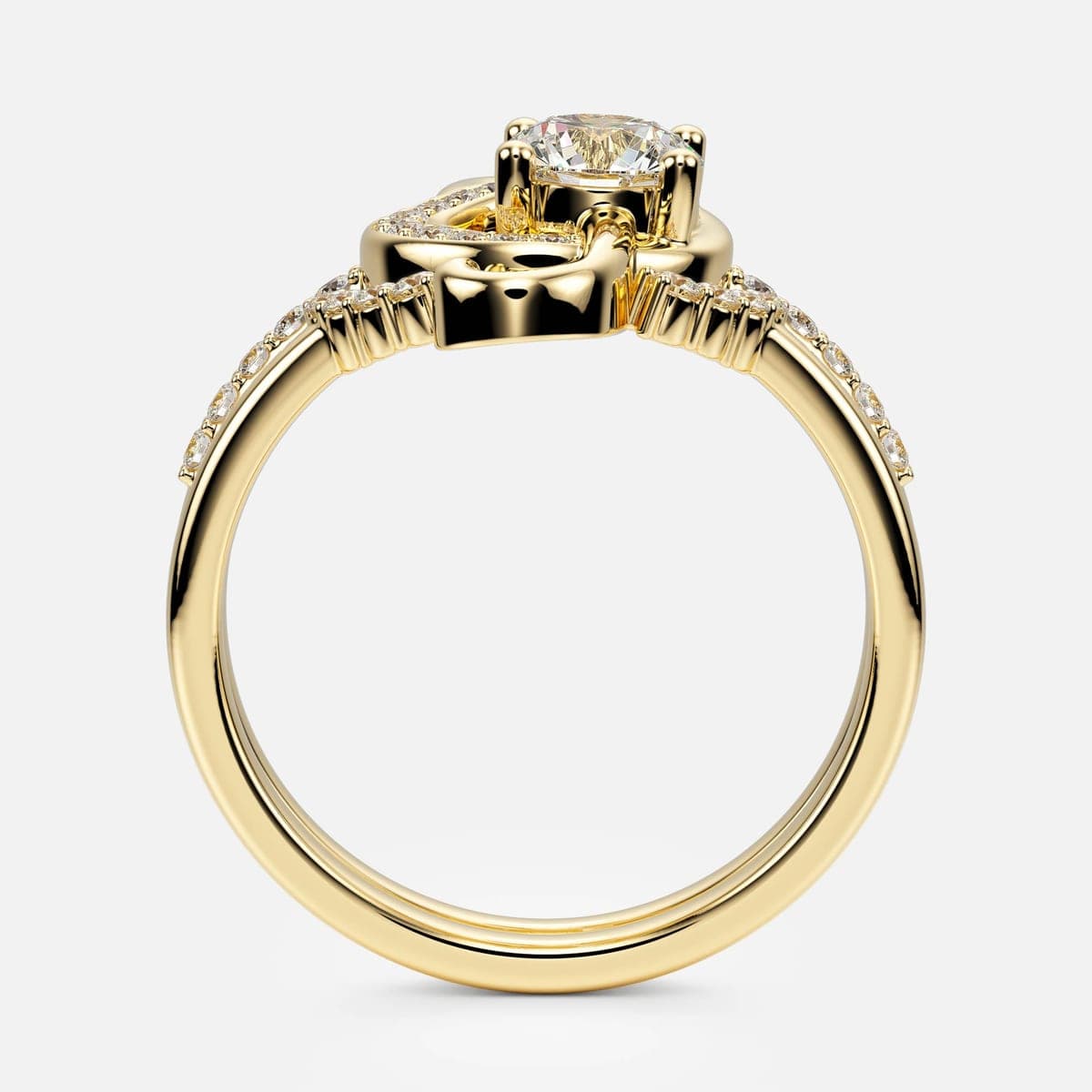
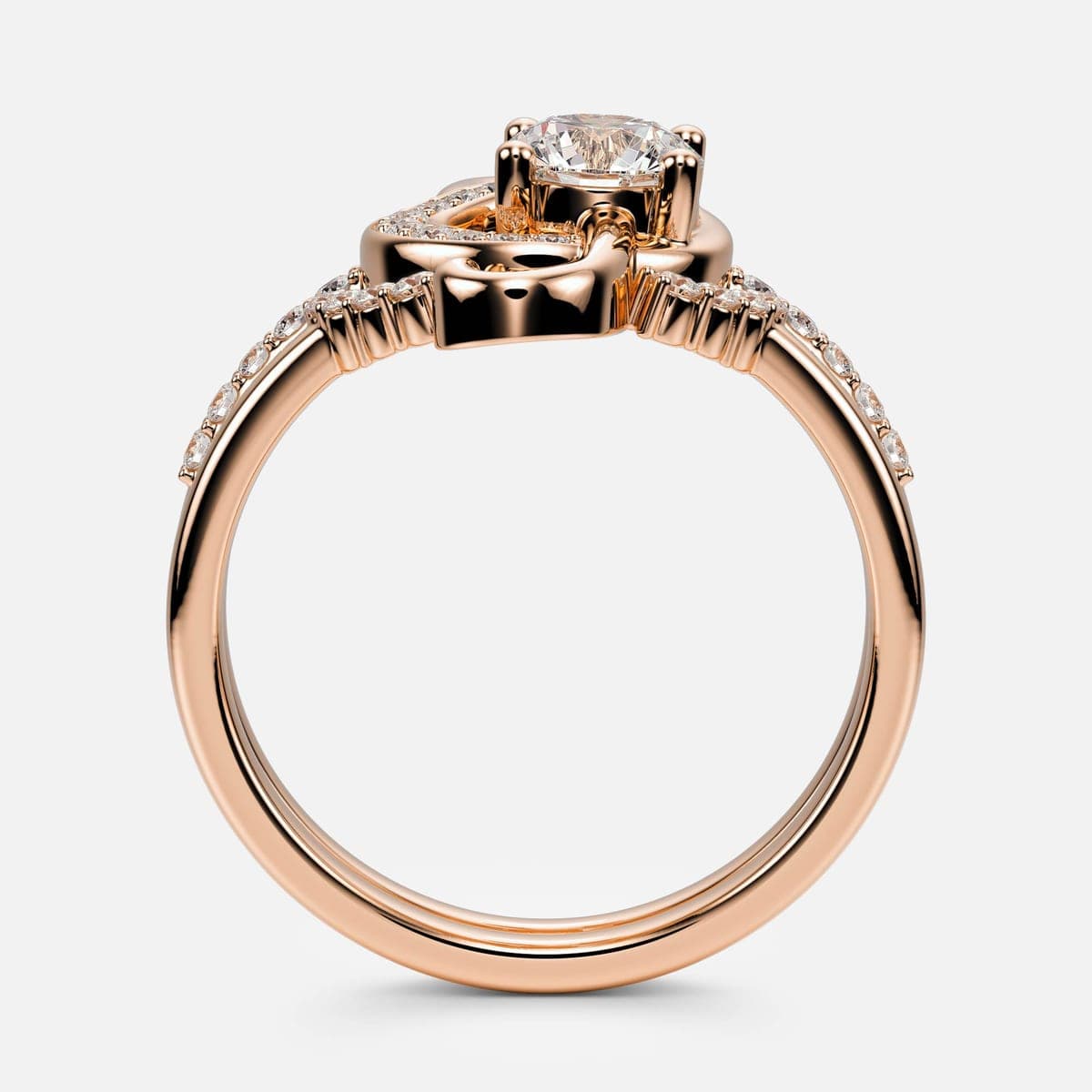
One finished model produces every image the piece will ever need, in every metal, without casting anything. The set was rendered in white, yellow and rose, from four angles each — the three-quarter that sells it, the top that proves the stone layout, the front that shows how the two bands nest, and the profile that shows how high it sits.
This is the argument for rendering before manufacturing rather than photographing after it. A sample in one metal answers one question. A model answers all of them, and every image is lit identically, so a product page built this way looks like one collection instead of three separate shoots.
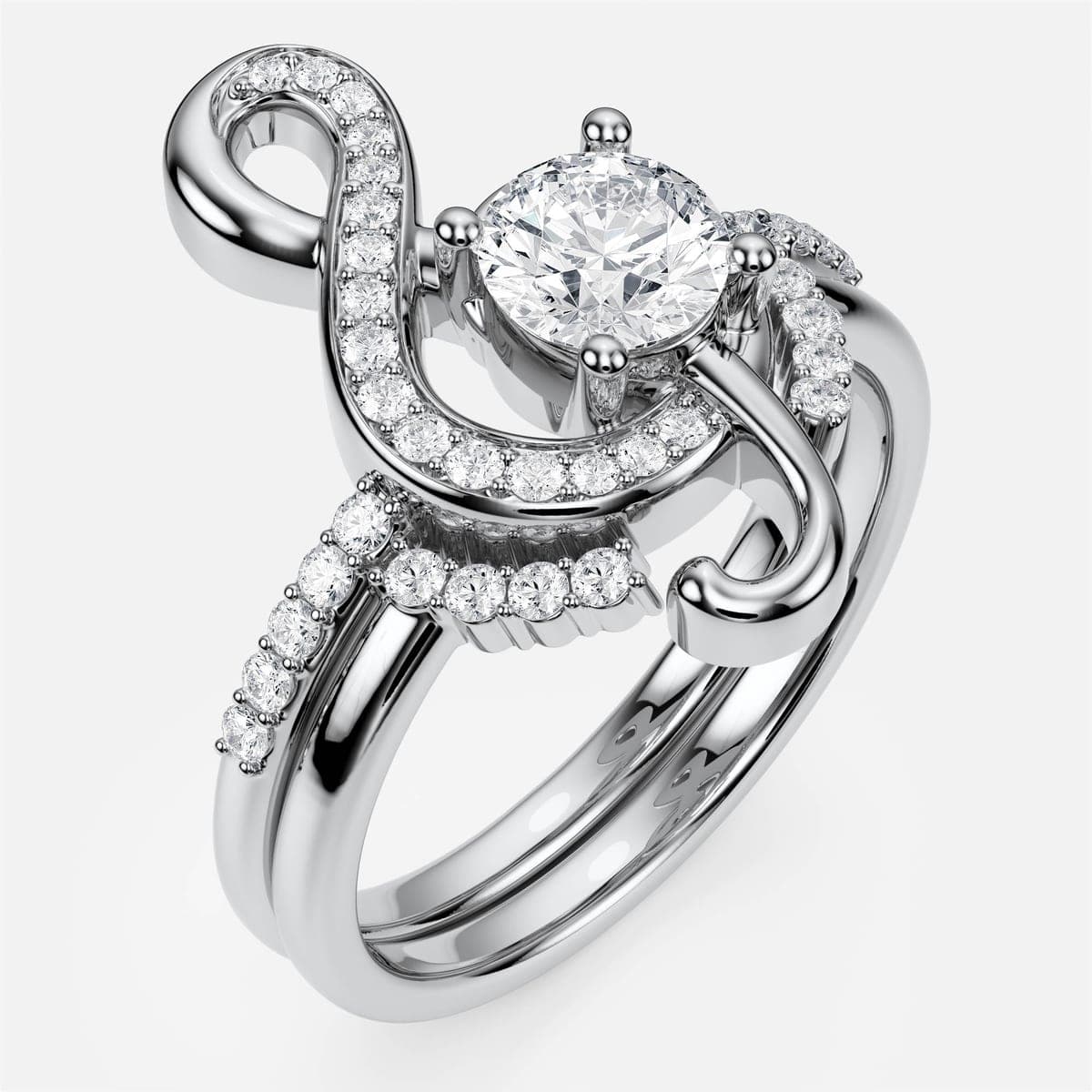
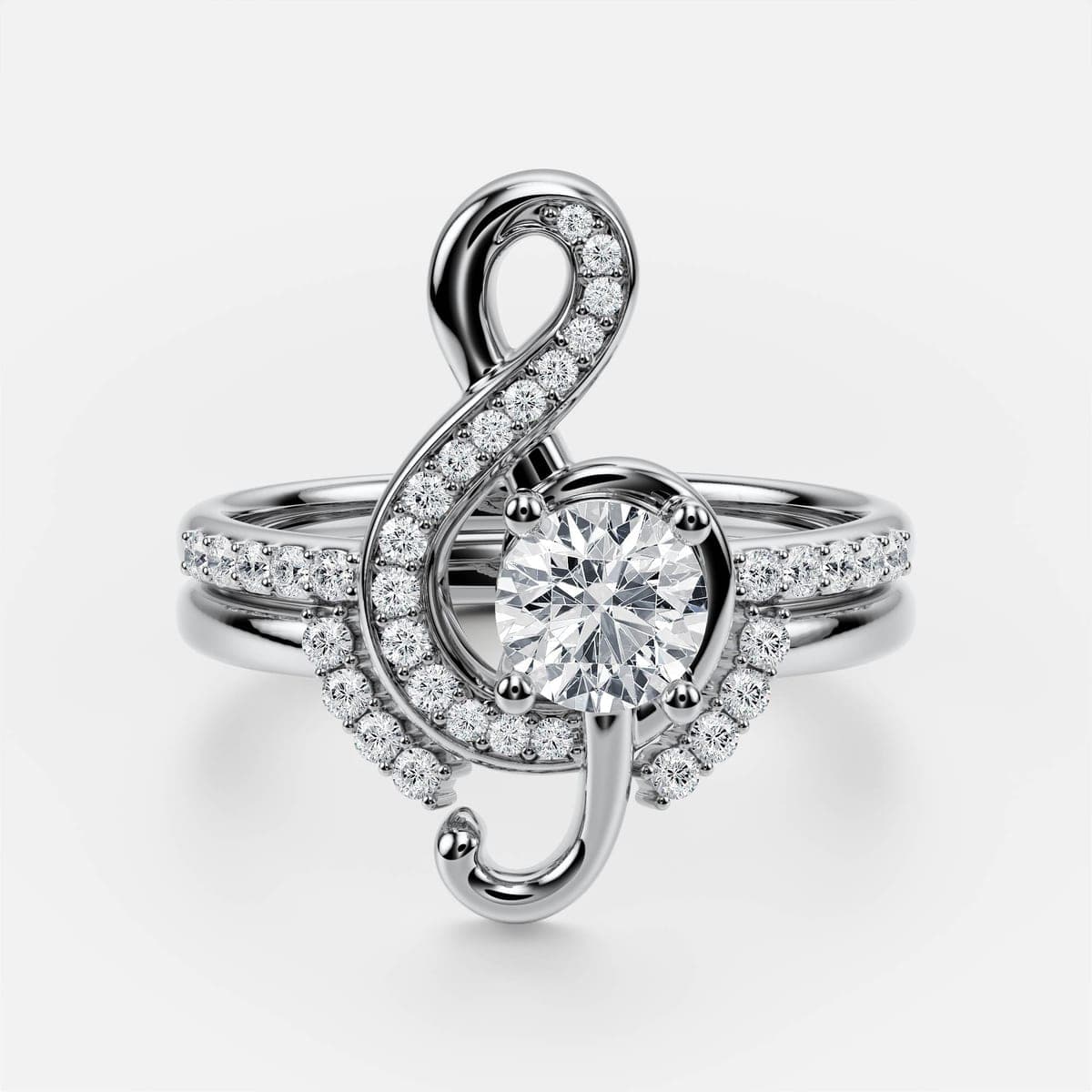
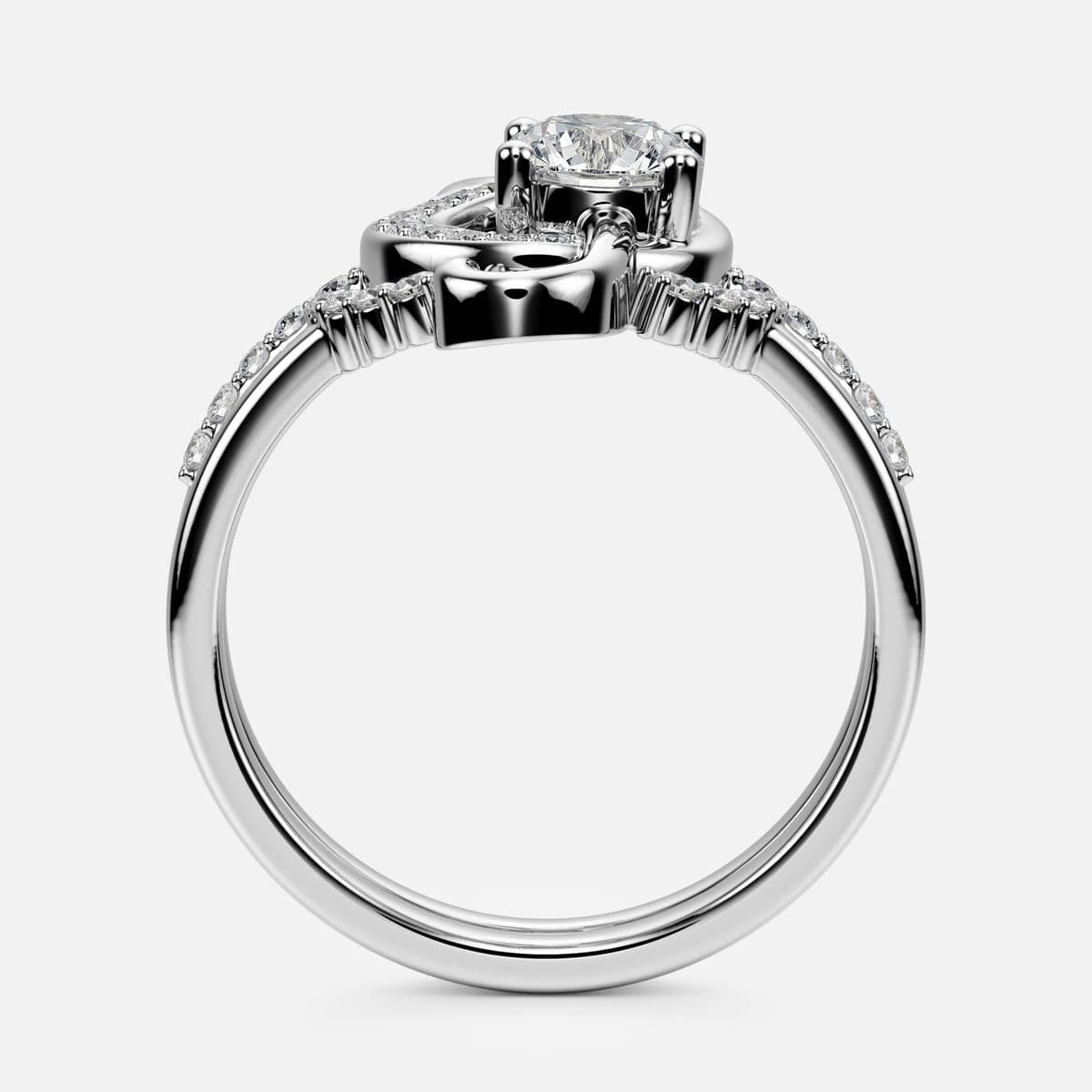
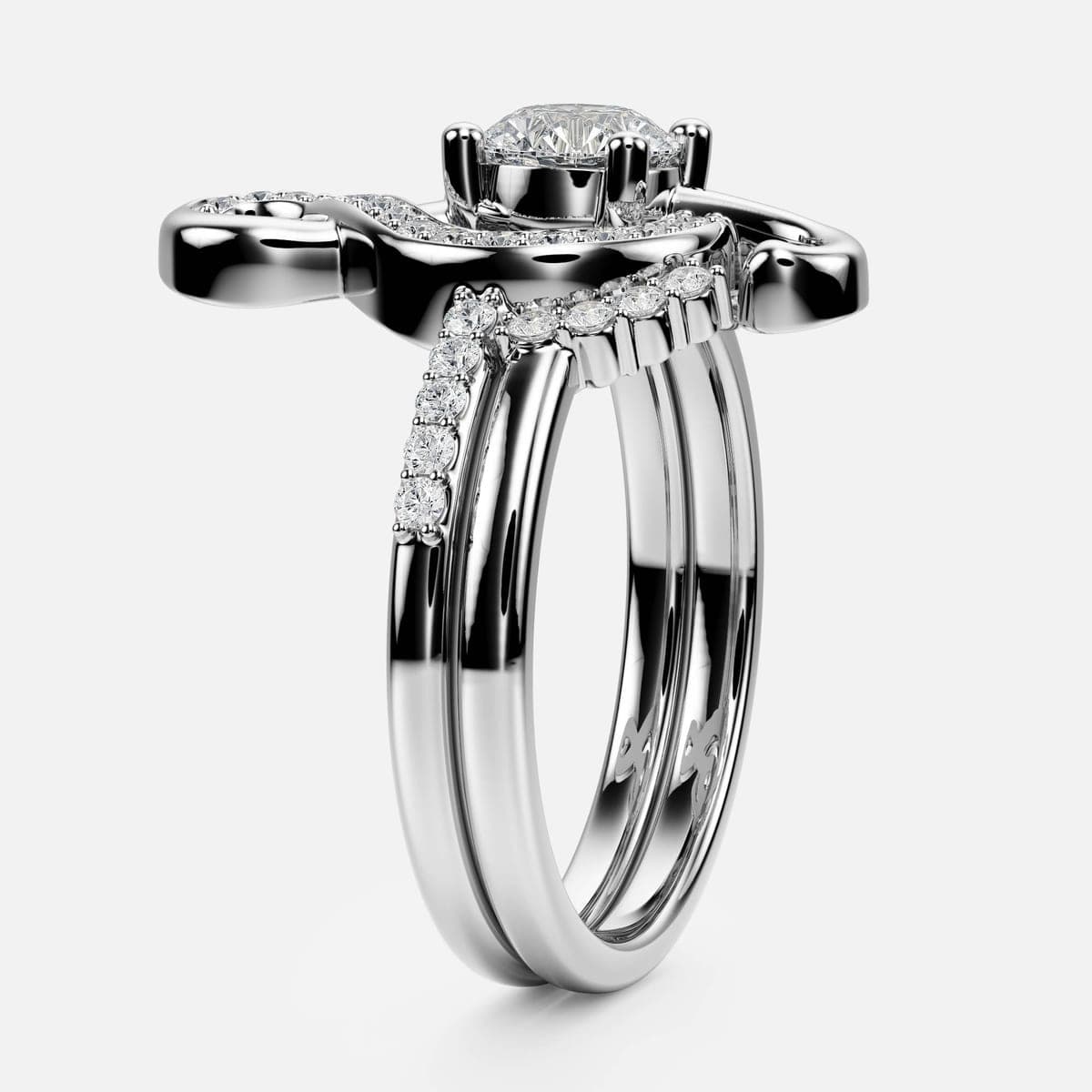
The same model, three metals
Nothing was remodelled between these images. The metal is a material change on a finished file, which is why a brand can test a colourway with a client before committing a single gram of anything.
It is also how a small catalogue grows quickly: one design, three finishes, twelve images, all consistent — and if the client asks for a lab-grown centre stone or a different size, that is a parameter, not a new job.
What this order actually cost in time
The honest breakdown, because the question behind every custom quote is really 'where does the time go':
The sketch is the cheapest hour in the project and the one that saves the most. Changes at sketch stage are conversation. The same change after the pavé is seated is re-seating the pavé.
- Concept sketch — hours, not days, and the only stage where the design is still soft.
- Technical plan — fast once the sketch is signed off, because it is transcription rather than invention.
- CAD — the bulk of the work: the clef's curve, 34 seats, two nesting bands and a wall-thickness pass at finished size.
- Rendering — a day for a set like this, most of it lighting and material setup that is then reused for every metal.
Why a jeweller would commission this rather than build it in-house
A shop that takes two or three custom orders a month cannot justify a full-time CAD seat, and the software licence is the smallest part of that cost. The expensive part is the accumulated knowledge of what a mould will and will not release, what a setter can reach, and how thin a platinum tail can be before it stops being a ring and starts being a repair.
Commissioning it per-piece turns that into a line item on the job, quoted before the client says yes. The files come back to you, under your brand, ready for whichever caster you already use. There is no studio credit on the images and no requirement to work with us again on the next one — a design you own is worth more than a design you rent.
Key takeaways
- A custom piece is settled in three documents before it is ever modelled: the sketch (proportion), the plan (dimensions and stone schedule) and the CAD file (physics).
- The gemstone schedule — every stone by diameter, quantity and position — is what lets a caster, a setter and a stone buyer all work from one sheet.
- On a shaped ring, the pavé steps down in diameter as the metal narrows; a single stone size either crowds the tip or gaps at the shoulder.
- Two rings that must nest have to be modelled together against one centreline. A wedding band designed afterwards gaps or fouls.
- One finished model produces every metal and every angle with nothing cast — three metals and twelve images from a single file.
- Changes are free at sketch stage, cheap at plan stage and expensive after the stones are seated.
Frequently asked questions
Can you work from a rough sketch, or do you need a technical drawing?
A rough sketch is normal and completely workable — most clients arrive with a phone photo, a reference from a shop window, or a description. We produce the rendered concept sketch first and get it approved, then draw the technical plan from it. If you already have a dimensioned drawing, we skip straight to CAD.
How many stones can a shaped ring like this hold?
This set carries 34: one 6.5 mm centre and 33 accents from 1.6 mm down to 1 mm. The limit is not the design — it is setting access and minimum wall between seats. Both are checked in CAD at finished size, because a seat that a graver cannot reach is a stone that never gets set.
Why platinum for a design with a thin tail?
Platinum is the safer choice for a cantilevered shape: it is denser and far more forgiving of a knock than 14k, which tends to crack rather than bend. The same model can be cast in gold, but the tail's wall thickness is re-checked against the alloy rather than carried over — alloys behave differently on fine sections.
Can the wedding band be worn on its own?
Yes, and it was designed for it. That is why its pavé line is continuous rather than shaped to hug the clef: the band spends most of its life as a band. Nesting is a property of the pair, not a compromise imposed on one of them.
Do I get the CAD files, or only the renders?
Both. You receive the 3DM and STL, print-ready, plus the renders — with full rights to use, modify and manufacture. Take the files to any caster or printing service you like; the design is yours and the studio works behind your brand.
How long does a custom set like this take end to end?
For a piece at this level of complexity, plan on the sketch within a couple of days of the brief, the model once the sketch and plan are approved, and rendering after that. Simple solitaires move considerably faster. We quote per piece once we have seen the reference and know the finished size — a number invented before that helps nobody.
Further reading
Have a piece you need in 3D?
Fixed pricing, real-time tracking, manufacturing-ready files — delivered worldwide.
Request a quote