
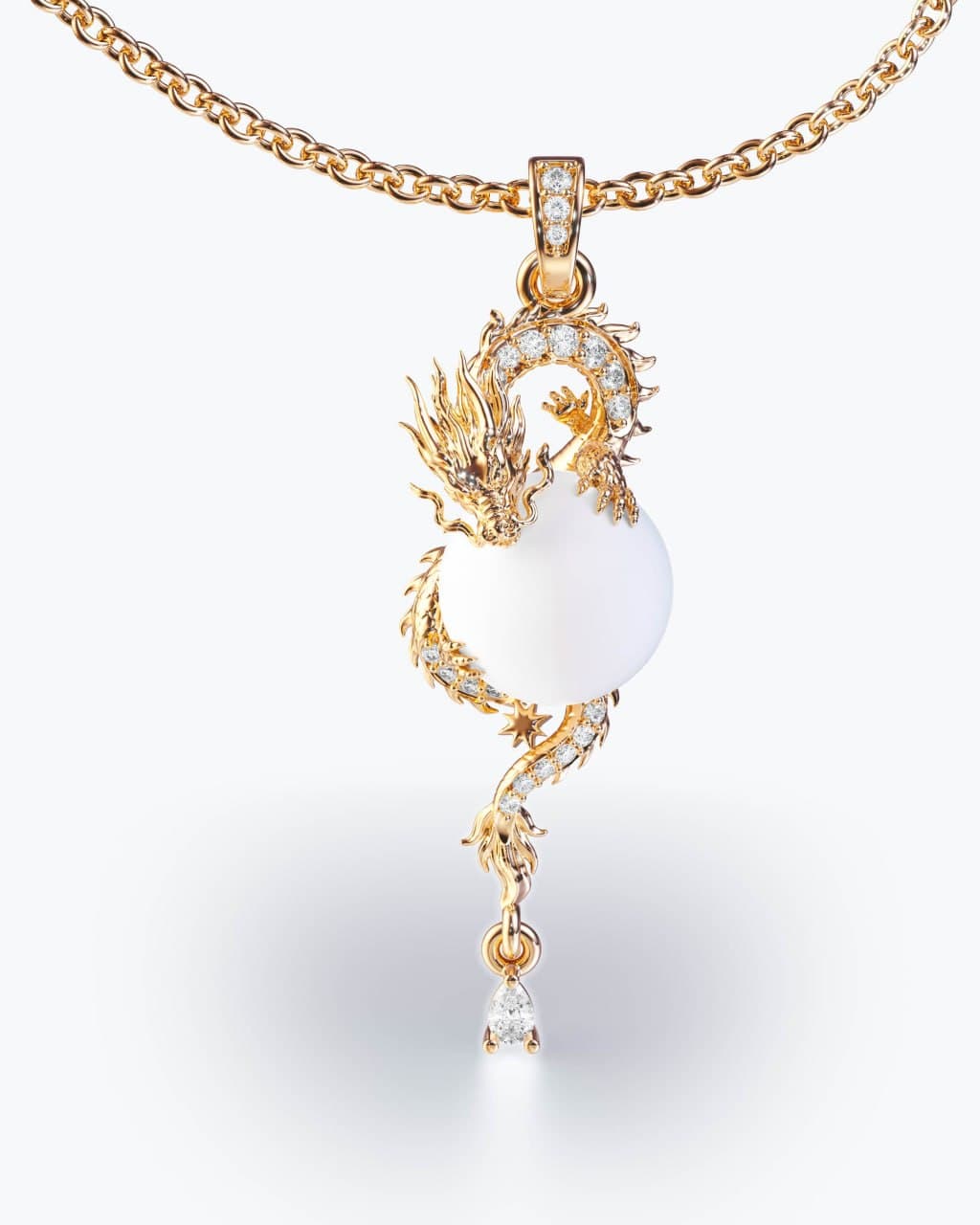
A dragon is the piece most designers want in their portfolio and the one most likely to come back from the caster wrong. It is rarely the sculpting that breaks it. Modern CAD will happily let you build a dragon that no mould can release, no setter can reach and no polisher can finish without eating the detail that made it worth making. The three pendants here were built to avoid exactly that — a dragon wrapped around a white gemstone sphere, in three variations, each modelled once and rendered in both white and yellow gold. This is what actually goes into a piece like this: the design decisions, the manufacturing constraints behind them, and why one clean model is worth more to a jewelry brand than any single photograph of it.
The dragon and the pearl
The motif is old. A dragon curled around a luminous sphere — chasing it, guarding it, playing with it — is one of the most persistent images in Asian decorative art, where the pearl stands for wisdom, prosperity and the thing worth protecting. It has survived on porcelain, on silk, in temple carving, and for the last century in jewelry. A buyer does not need any of that explained to feel it, which is precisely why the motif keeps selling.
Commercially it is one of the few designs that crosses categories. The same idea works as a men's statement pendant on a heavy chain, as a zodiac gift, and as a fine piece in 18k with pavé and a diamond drop. Demand for it is steady rather than seasonal — worth knowing for a brand deciding what to keep in a catalogue year-round instead of chasing the next trend cycle.
What has changed is who can make one. Hand-carving a dragon in wax is a specialist craft measured in days, and every copy is a new carving. In CAD the difficulty does not disappear — it moves. It becomes a set of decisions you make once, in a file, that then repeat perfectly forever. That shift is what turns a single showpiece into a product line.
Three dragons, one brief
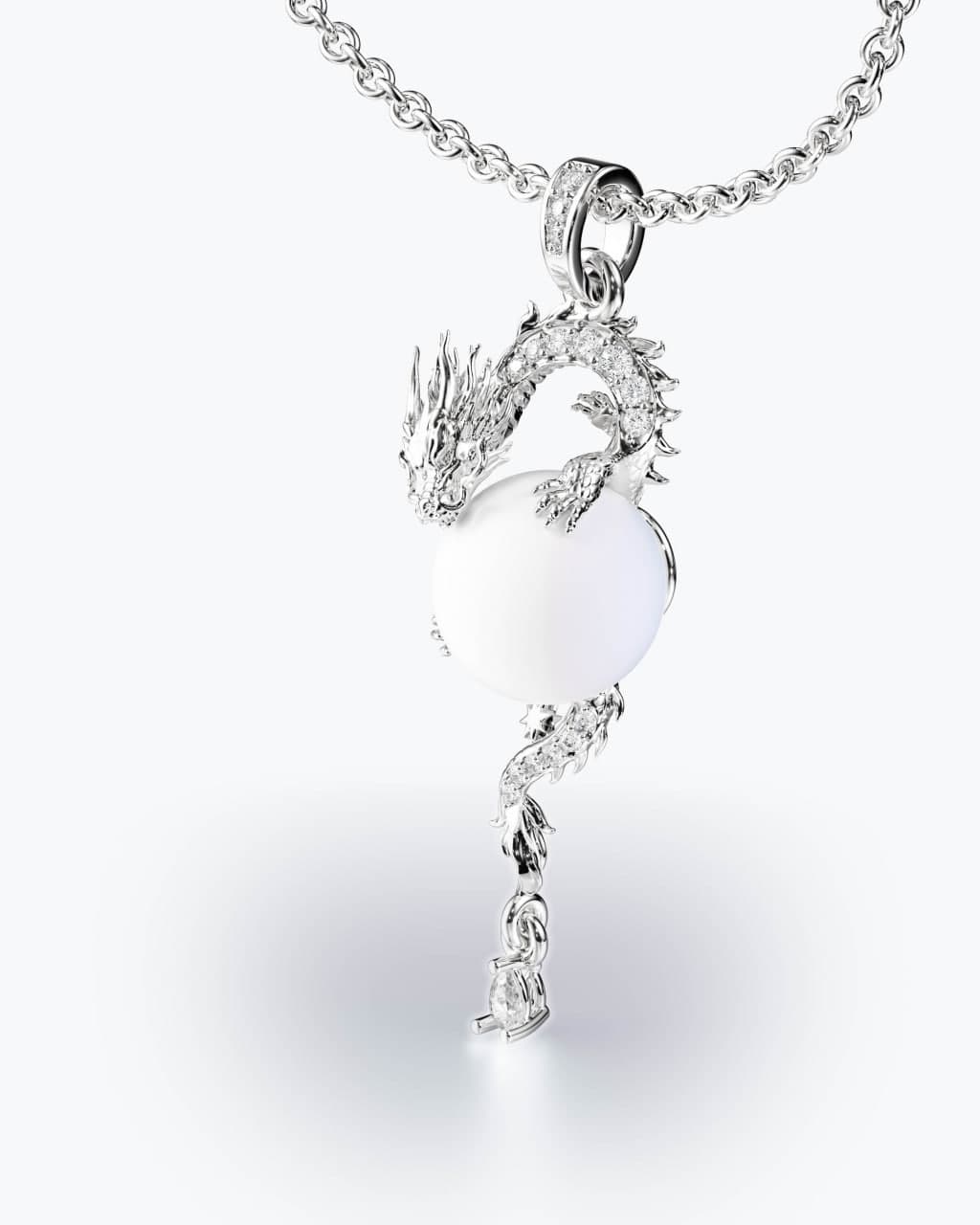
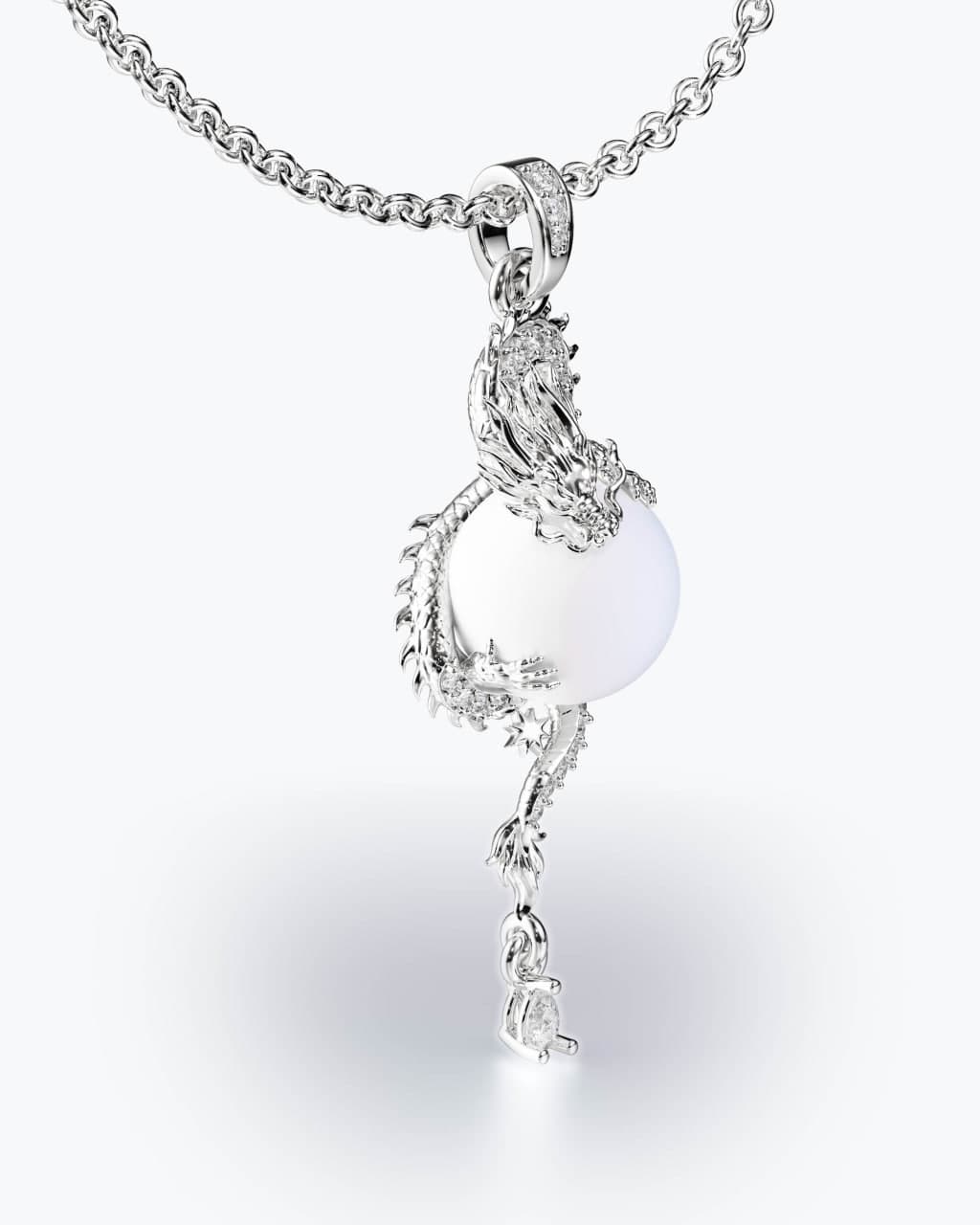
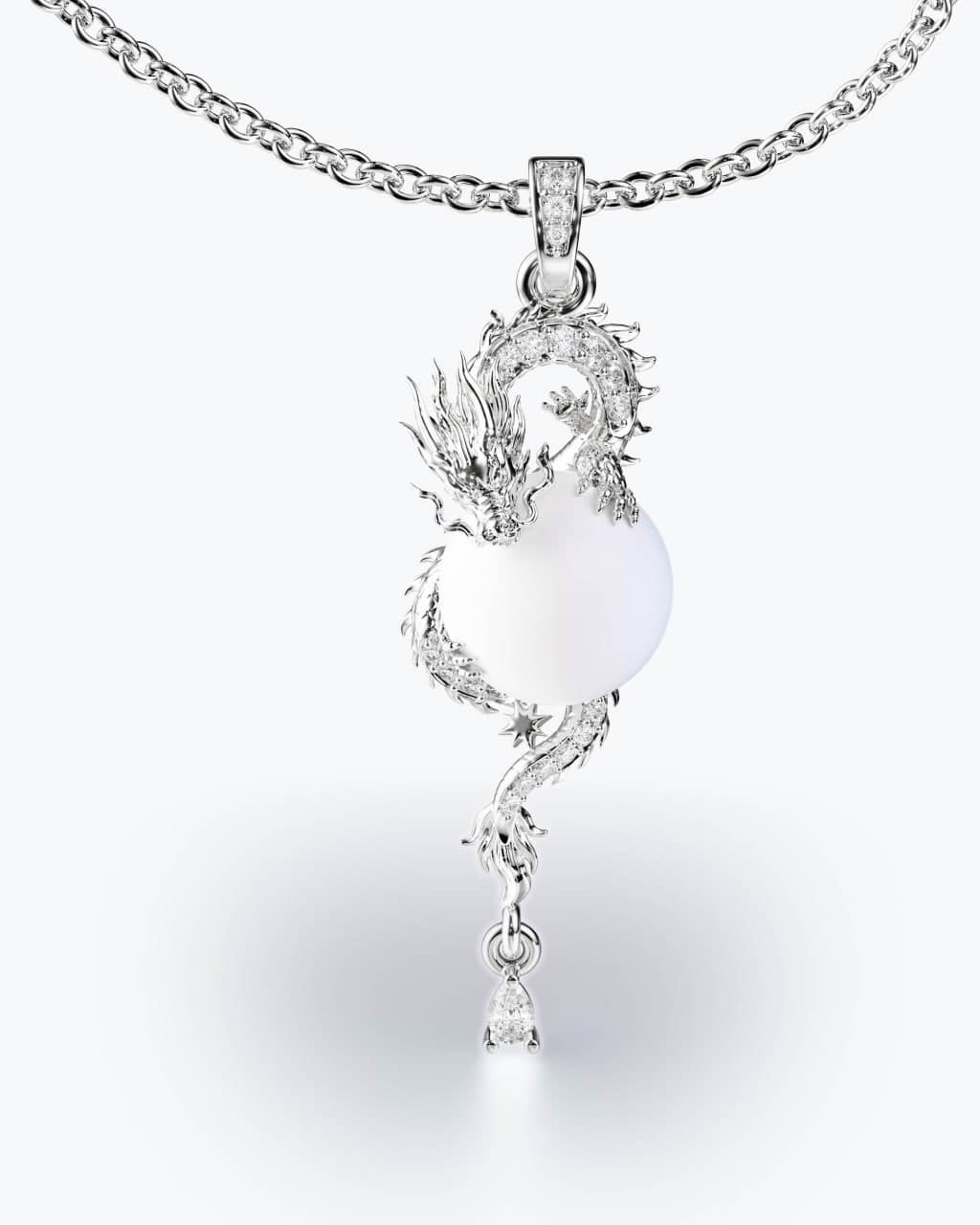
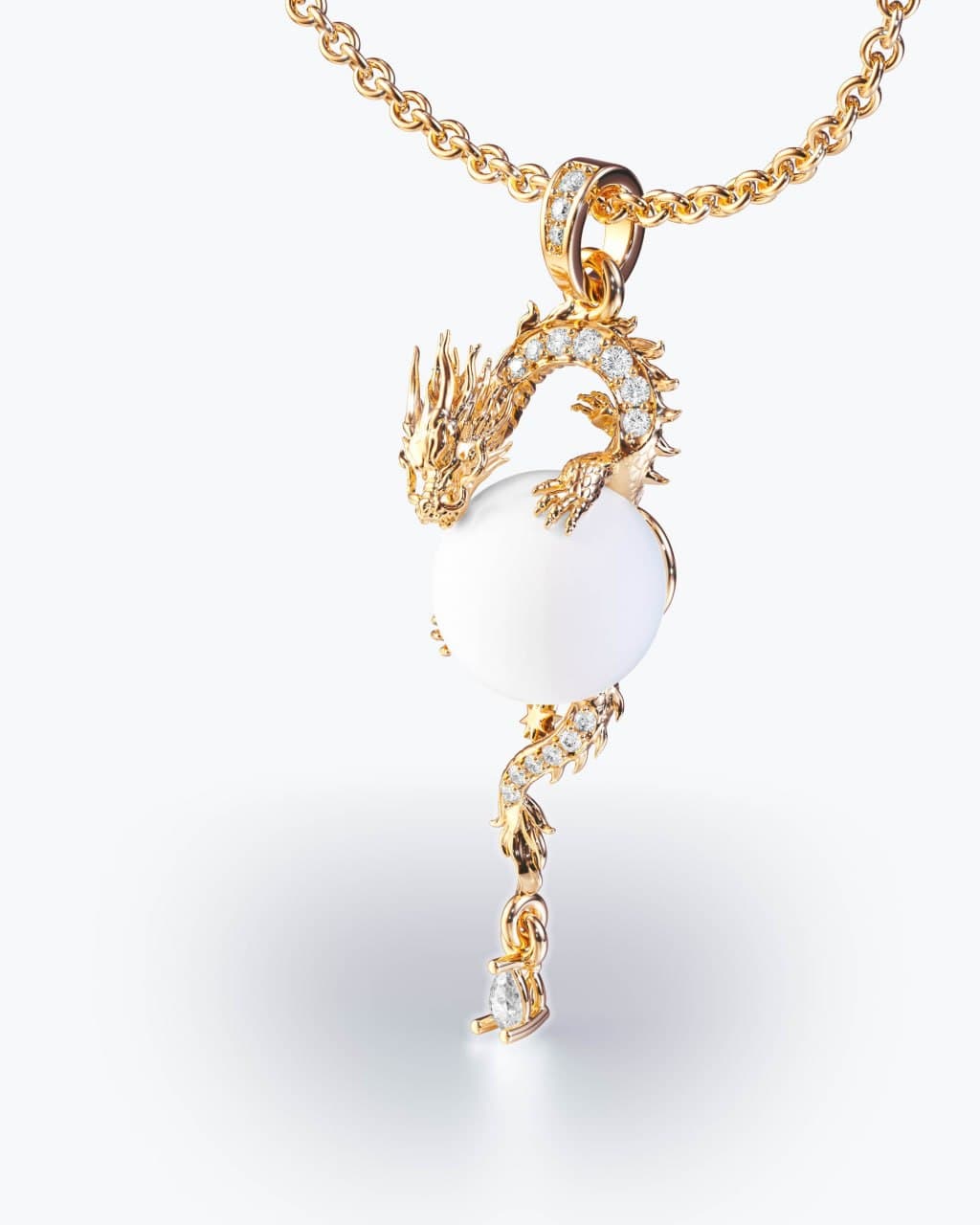
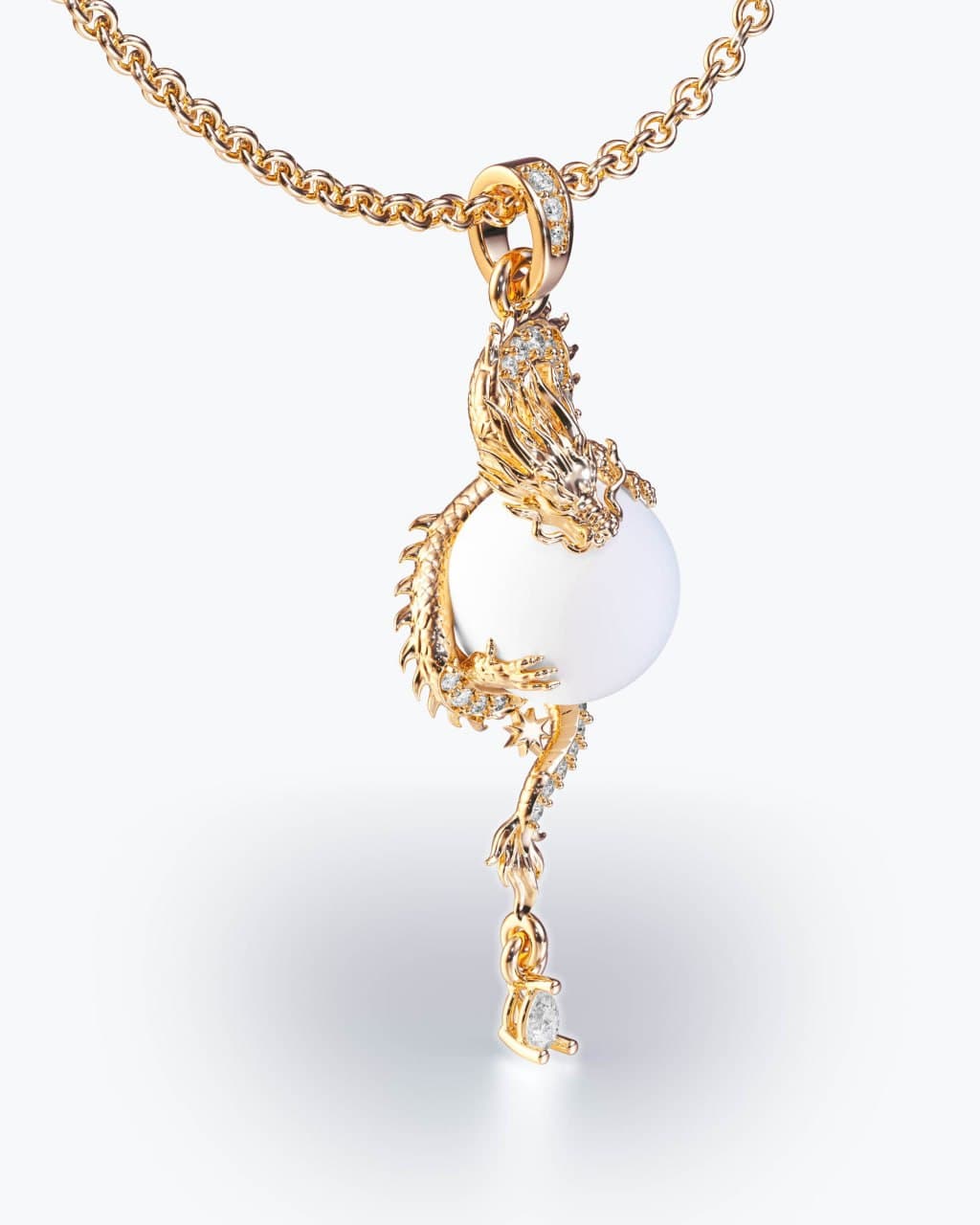
The brief was one idea in three temperaments, so a retailer could carry a family rather than a single item. All three share a design language — pavé running along the spine, claws in real contact with the stone, and a tail that descends past the sphere to terminate in a pear-shaped diamond hanging in a three-prong basket.
The Arc lifts over the top of the sphere with the head turned outward and one claw resting on the stone. It is the most open of the three, so light passes under the body and the sphere reads bright. The Coil wraps the stone with the head brought forward and down — the tightest silhouette, the most metal, and the one that holds up best at smaller sizes. The Flame carries the fullest mane and a tapered pavé bail: the most decorative of the set, and by some distance the most demanding to set and finish.
The sphere is shown here as a white gemstone. The same model accepts white jade, agate, mother-of-pearl or a large freshwater pearl with no change beyond the seat diameter — a useful lever when a brand wants a price ladder without a second design.
What makes a dragon hard to model
Every organic pendant fights the same four opponents: the mould, the setter, the polisher and gravity. A dragon fights all four at once, and it does so at a scale that flatters nothing. On screen the model is effectively a metre tall. In the hand it is about the size of a thumb joint. Almost every mistake in a piece like this traces back to designing for the first of those and not the second.
None of what follows is visible in the finished renders, which is rather the point. The images are the proof that the decisions were made; the file is what the factory actually needs.
| Where it goes wrong | Why | What we do about it |
|---|---|---|
| Scales and mane | Detail modelled at viewport scale disappears at 25 mm — or fills with compound on the polishing wheel | Cut depth and spacing are set against the finished size, and relief is exaggerated wherever it has to survive finishing |
| Undercuts | A mould has to open. Geometry that hooks back on itself tears rubber or traps wax | Claws, whiskers and mane are angled to a defined draw direction; anything that cannot release becomes a separate assembled component |
| Pavé on a compound curve | Seats that naively follow a spine twisting in two axes leave stones reading crooked | Seats are distributed along a fitted rail, then re-oriented to the local normal so every table faces the viewer |
| Claws on the sphere | A claw that only touches the stone in the render will not hold it in metal | Contact is modelled as real bearing surface against the stone's actual diameter, with tolerance — not a visual overlap |
| Whiskers and thin tips | Sections below the alloy's flow limit come out short-filled, or snap during finishing | A minimum wall is enforced across the model, with tapers thickened toward the root where the eye does not read it |
| The tail drop | A rigidly attached drop transmits every knock straight into the thinnest part of the piece | The pear-shaped diamond hangs from its own jump ring, so the joint moves instead of the tail |
| The bail | Bails designed to look right often will not pass the chain the client actually sells | Inner clearance is taken from the chain gauge, and pavé is kept off the surface the chain wears against |
The same model, two metals
Every image in this article comes from the same three CAD models. Nothing was re-sculpted to change metal — a white gold pendant and a yellow gold pendant are one file with a different material assigned, re-rendered. That is machine time, not studio time.
For a brand, this is the entire commercial argument. A photograph gives you one piece, in one metal, under one lighting setup, and only after the piece physically exists — which means a sample, a caster, a setter and a photographer before you have anything to put on a product page. A model gives you every variant of a piece that has not been made yet, all lit identically, which is also why a catalogue built this way looks coherent instead of assembled from six different shoots.
| Change | What it actually costs |
|---|---|
| White, yellow or rose gold | A material swap and a re-render. The geometry is untouched |
| 14k, 18k or platinum | No model change — weight and price change, and platinum wants slightly heavier minimum walls |
| A different sphere or centre stone | A seat adjustment to the new diameter |
| Scaling the whole pendant | A scale plus a re-check of minimum wall — not a rebuild |
| Adding a matching ring or earrings | Reuses the sculpted head and scale library, so the second piece costs a fraction of the first |
From render to metal
A render that cannot be manufactured is an illustration. What separates the two is the handover — the set of files and information a factory needs to produce the piece without calling you back with questions.
- A watertight, manifold solid — not a mesh with holes that a slicer will silently 'repair' into the wrong shape
- The format the shop actually wants: STL for printing, 3DM or STEP where the manufacturer needs editable geometry
- A stone list with sizes, so the setter can order before the casting arrives rather than after
- A wall-thickness check against the chosen alloy, not against a generic default
- Separate components for anything that must be assembled — here, the diamond drop and its jump ring
What this costs a brand to own
The expensive part of a dragon is the dragon. Sculpting the head, the scale library and the mane is where the hours go; once that exists, the range around it is comparatively cheap. A matching ring, a pair of earrings or a second colourway draw on work that has already been paid for.
That is the case for treating CAD as an asset rather than a line item. A photograph depreciates the moment the piece sells out. A model keeps producing — new metals, new stones, new sizes, new images — for as long as the design stays in the catalogue.
Key takeaways
- A dragon fails in manufacturing for four reasons — mould release, setting access, minimum wall and finishing — and all four are settled in CAD, long before anything is cast.
- Detail has to be designed at finished size. What reads beautifully in the viewport can vanish entirely at 25 millimetres.
- Claws that touch the stone only in the render will not hold it in metal; contact must be modelled as a real bearing surface.
- One clean model produces every metal, every stone option and every image — with no sample and no reshoot.
- Once the sculpting exists, a matching ring or pair of earrings costs a fraction of the first piece.
Frequently asked questions
How long does it take to model a dragon pendant in CAD?
Considerably longer than a solitaire, and it depends almost entirely on how much of the creature is genuinely sculpted rather than assembled from a library. The head, mane and scale work carry most of the hours; the bail, drop and chain are quick by comparison. We quote it per piece once we have seen your references and know the finished size, because guessing at that stage helps nobody.
Can a dragon pendant be cast in one piece?
Most of it, yes. The body, head, mane and tail are designed to release from a single mould in one draw direction. The diamond drop is deliberately separate — it hangs from its own jump ring so the joint absorbs knocks instead of the thinnest part of the tail. On heavily maned versions an ornate bail is sometimes cast separately and assembled as well.
Will a design like this work in silver, or only in gold?
It works in silver, and it is a sensible way to open a lower price tier. The model needs a wall-thickness pass first: silver and gold alloys behave differently on fine detail such as whiskers and mane tips, so minimums are re-checked against the alloy you are actually casting rather than carried over.
Why render a piece instead of photographing the finished one?
Because the render exists before the piece does. You can show a design in white, yellow and rose gold, with different stones and at different sizes, without producing a single sample — and every image is lit identically, so a catalogue built this way looks coherent rather than stitched together from separate shoots. Photography still has its place; it just cannot come first.
Do I own the CAD files at the end?
Yes. You receive full rights to use, modify and manufacture from the delivered files, and you can take them to any caster or printing service you choose. Ownership of the design stays with you — the studio works behind your brand.
What do you need from me to start a piece like this?
Reference images or sketches, the finished dimensions you want, the metal and karat, and a stone list if you already have one. If you only have an idea and no drawing, that is workable too — we sketch the concept first and get it approved before any modelling time is spent.
Further reading
Have a piece you need in 3D?
Fixed pricing, real-time tracking, manufacturing-ready files — delivered worldwide.
Request a quote