
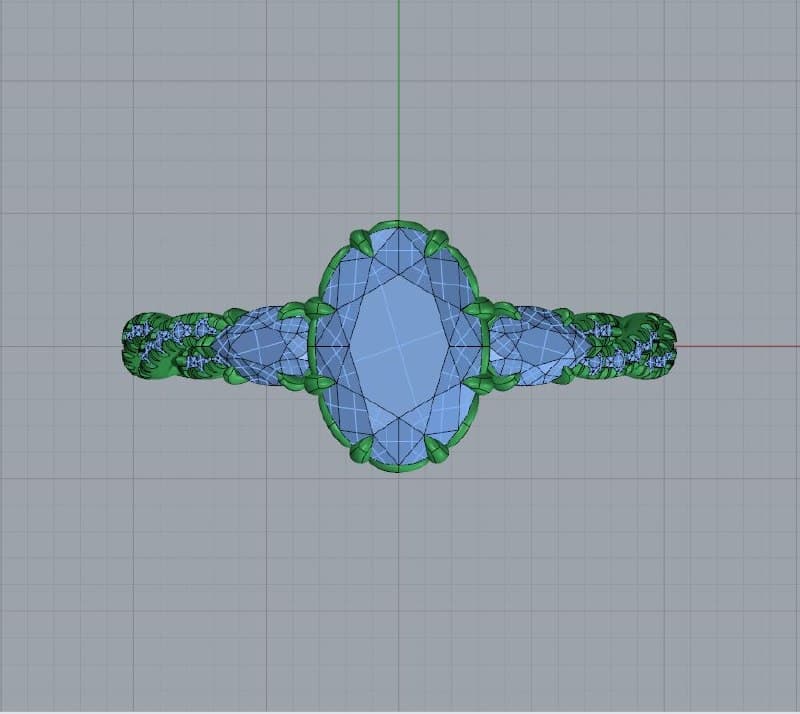
The file format you deliver decides whether a piece casts cleanly, prints at the right size, or renders like studio photography. For jewelry specifically, the wrong format — or the right format at the wrong resolution — is one of the most common causes of failed casts and reworked models. This guide breaks down the five formats you'll actually encounter and when to use each.
The short answer
Different stages of a jewelry project need different formats. There is no single 'best' file — there is a best file for casting, a best file for editing, and a best file for imagery.
| Format | Best for | Editable later? |
|---|---|---|
| STL | 3D printing & casting | No (mesh only) |
| 3DM (Rhino) | Editable CAD, manufacturing hand-off | Yes (NURBS) |
| OBJ | Rendering, sculpting hand-off | Partially (mesh) |
| FBX | Animation & scene transfer | Partially |
| GLTF/GLB | Web & AR viewers | No |
STL — the printing and casting standard
STL describes a surface as a mesh of triangles. It is the universal input for resin 3D printers and CNC wax mills, which makes it the format most casting houses ask for.
The catch is resolution. Too coarse a mesh and you'll see faceting on curved shanks and bezels; too fine and the file becomes unwieldy without adding real detail. For jewelry, the mesh should be dense enough that facets disappear at print scale but no denser. STL also carries no units reliably, so always confirm the piece is exported at true millimeter size.
3DM — the editable master
A Rhino .3dm file stores true NURBS geometry: mathematically exact surfaces that can be re-edited, re-scaled and re-measured without loss. This is the format you want as your master file, because a mesh (like STL) can only be printed, not meaningfully changed.
Deliver a 3DM when the manufacturer needs to tweak tolerances, adjust finger size, or reuse the model for a variant. It preserves stone-setting measurements and lets a jeweler verify prong and gallery clearances precisely.
OBJ, FBX and GLTF — imagery, motion and the web
OBJ is a mesh format widely used to move models between sculpting tools (like ZBrush) and renderers. It supports high-detail surfaces and is a common hand-off between a sculptor and a rendering artist.
FBX adds cameras, lights and animation data, so it's used when a piece needs a turntable or motion sequence. GLTF/GLB is the lightweight format for interactive web and AR viewers — small, fast, and designed for browsers rather than manufacturing.
A safe default delivery
For most manufacturing projects, delivering both an STL (for immediate printing) and a 3DM (as the editable master) covers you. Add an OBJ if the same model will be rendered for e-commerce.
- Casting/printing: STL at true mm scale, appropriate mesh density
- Editable master & tolerance changes: 3DM (NURBS)
- Rendering / e-commerce imagery: OBJ or the native render scene
- Web & AR product viewers: GLTF/GLB
Key takeaways
- STL is for printing and casting — always export at true millimeter size.
- 3DM (NURBS) is your editable master; a mesh can't be meaningfully re-edited.
- OBJ/FBX/GLTF are for imagery, motion and the web, not manufacturing.
- When in doubt, deliver STL + 3DM together.
Frequently asked questions
What file format do jewelry casting houses need?
Most casting houses and resin printers require an STL exported at true millimeter scale with a mesh density fine enough that facets are invisible at print size. Supplying a 3DM alongside it lets them adjust tolerances if needed.
Can an STL file be edited after export?
Not meaningfully. An STL is a fixed triangle mesh — you can repair or rescale it, but you cannot cleanly re-edit surfaces or settings. Keep a NURBS master (.3dm) for real edits.
Which format is best for e-commerce jewelry images?
Rendering is usually done from an OBJ or the native scene file of the rendering software. GLTF/GLB is the right choice only for interactive web or AR product viewers.
Further reading
Have a piece you need in 3D?
Fixed pricing, real-time tracking, manufacturing-ready files — delivered worldwide.
Request a quote